
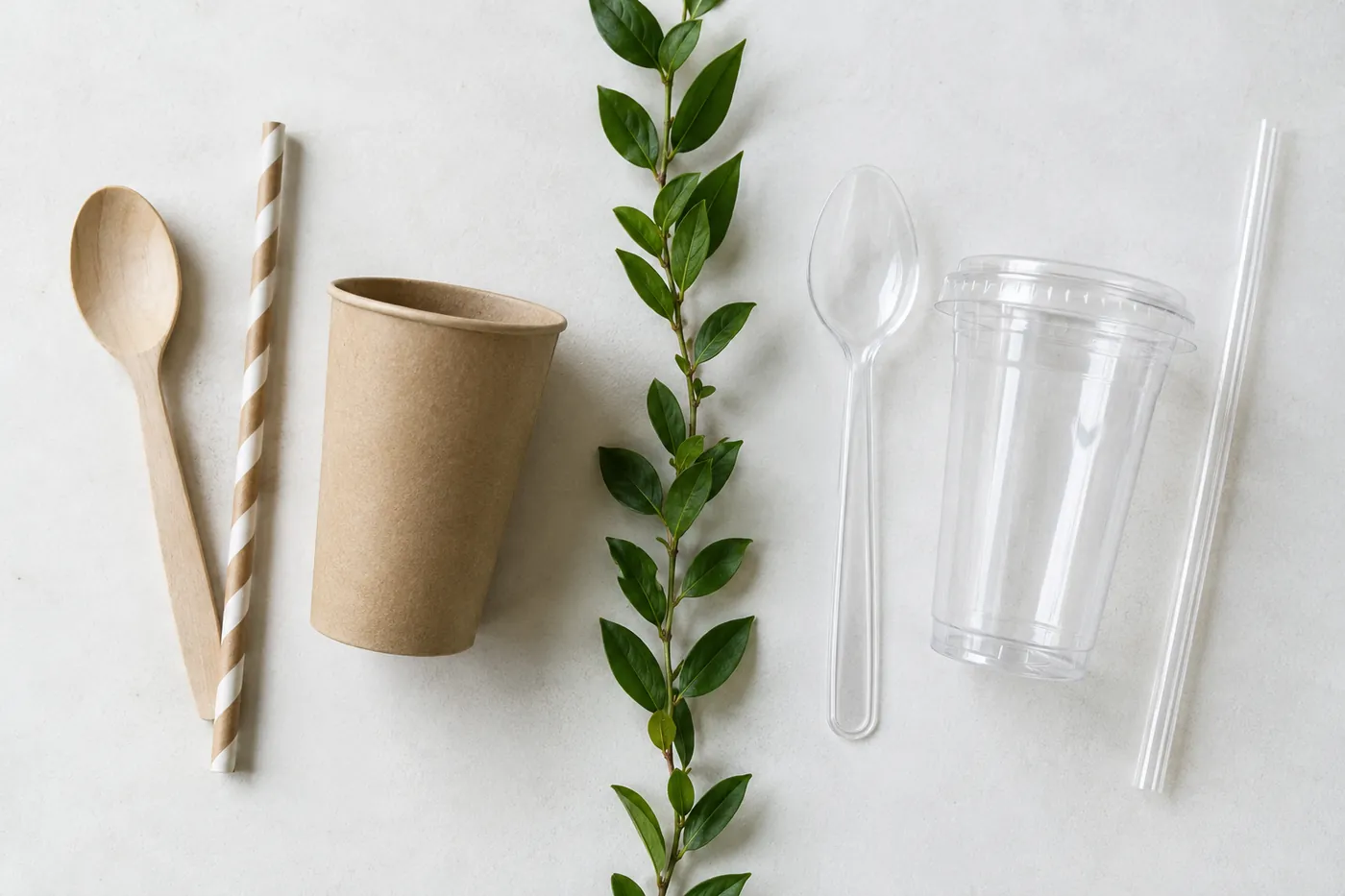
Which eco materials are OK in your market?
The EU counts PLA and other bio-based plastics as plastic; US rules change state by state. That's why we ask where you sell before we quote.
Choose a market
Thirteen common material groups across six market regions.
- Recommended allowed, supplied with the right documents
- Verify first allowed with conditions, or depends on state
- Not offered we don't supply it there
- Pick your marketUse the market tabs to switch region.
- Check each materialNotes explain the condition behind “Verify first”.
- Send your item listWe mark every item for your exact destination and suggest an alternative where needed.
Selling in more than one market? Send the list once — we check it against each destination before quoting.
Material summary: EU
Tap a market to see which materials we recommend, verify first, or don't offer.
- Choose a market to see the material summary.
Summary as of October 2026, not legal advice. Rules change and differ by state and city — we confirm them for your destination before every quote.
Key rules by market
European Union EU
The Single-Use Plastics Directive has banned plastic cutlery, plates, straws, stirrers and foam food containers since 2021 — and bio-based or ‘biodegradable’ plastics such as PLA count as plastic. From 12 August 2026 the Packaging and Packaging Waste Regulation also limits PFAS in food-contact packaging.
- Recommended
- Wood and bamboo cutlery · paper straws · paper cups, bowls and boxes · reusable straws
- Verify first
- PE-lined paper cups need the ‘plastic in product’ marking · bagasse ships with a PFAS test report · whether PHA straws count as plastic is confirmed per item
- Not offered
- PLA, CPLA and PSM cutlery · PLA and PP straws
United Kingdom UK
England bans plastic straws and stirrers, and single-use plastic cutlery, plates, some bowls and foam containers — biodegradable plastics included.
- Recommended
- Same as the EU
- Verify first
- Scotland and Wales have slightly different rules
- Not offered
- Same as the EU
United States USA
There is no federal ban: states and cities set their own rules. Many states ban intentionally added PFAS in food packaging, and some regulate ‘compostable’ labelling.
- Recommended
- Almost every category · CPLA and PLA items with BPI certification
- Verify first
- For California, Washington and similar states, ‘compostable’ claims need certificate support
- Not offered
- Anything labelled ‘biodegradable’ without certification
Canada CA
The Single-use Plastics Prohibition Regulations ban plastic cutlery, straws, stirrers and certain plastic foodservice ware.
- Recommended
- Wood and bamboo cutlery · paper straws · paper and bagasse ware
- Verify first
- Compostable plastics (PLA / CPLA) are likely covered too — confirmed with you before order
- Not offered
- PP straws · plastic cutlery
Australia & New Zealand AU / NZ
Each state sets its own rules. Most have banned plastic straws, cutlery, plates and foam containers, and many include biodegradable plastics.
- Recommended
- Wood and bamboo cutlery · paper ware · bagasse ware
- Verify first
- PLA is treated differently by state — checked per destination
- Not offered
- PP straws · plastic cutlery
Middle East, Southeast Asia & Latin America ME / SEA / LATAM
Rules are generally lighter, but the UAE and others are phasing in bans. Price competitiveness matters most.
- Recommended
- The full range
- Verify first
- New rules are checked country by country each year
- Not offered
- No fixed exclusions — decided by country
Three rules we apply everywhere
PSM is not compostable.
Plant-starch blends (PSM) contain a large share of PP and do not fully break down. We describe them only as ‘partially bio-based’.
Home-compost and marine claims need certificates.
Claims such as ‘home compostable’ or ‘marine degradable’ are used only when a matching certificate, for example TÜV OK compost HOME, covers the exact product.
Fibre and grease-resistant paper need PFAS reports.
Bagasse and grease-resistant paper items ship with PFAS test reports. EU limits include 25 ppb for any single targeted PFAS and 50 ppm for total PFAS, with no transition period.
Use temperatures
| Material | Use temperature | Microwave | Good for | Avoid |
|---|---|---|---|---|
| PE / PLA lined paper cups & bowls | 0–100 °C | No | Hot drinks, hot soup, cold drinks | Long soaking in oil |
| Sugarcane bagasse | approx. −10–120 °C | Yes | Hot meals, rice, microwave reheating | Long soaking in a lot of liquid |
| Plant-starch containers | −5–120 °C | Yes (not oven) | Hot takeaway | Markets that require compostable claims |
| Clear PLA | 0–45 °C | No | Cold drinks, salads, fresh food | Any hot food; insulate containers on long summer voyages |
| CPLA cutlery | up to 85 °C (conservative) | No | Hot meals and soups | EU, UK, Canada |
| Birch wood / bamboo cutlery | wood −20–80 °C · bamboo −20–70 °C | No | Cutlery for every market | Buyers who need clear or coloured cutlery |
Ratings come from supply specifications for normal food-service use and are confirmed per item at quotation. Not a warranty.
Take this guide with you
All markets, the 13 × 6 material table, use temperatures and a pre-order checklist in one PDF to share with your team.
Get the PDFThis guide summarises public rules as of October 2026 for planning. It is not legal advice. UK, US state, Australia / NZ and Middle East rules are summarised at a general level and confirmed for the exact destination before each order.
Not sure what's allowed for your order?
Send your item list and destination. We'll mark each item and suggest an alternative where needed.